BioScience · 2026

Citation self-awareness for a fairer academic publishing landscape

Beck M., Annasawmy P., Birre D., Busana M., Casajus N., Coux C., Marino C., Mouquet N., Nicvert L., Oliveira B.F., Petit-Cailleux C., Tortosa A., Unkule M., Vagnon C., Veytia D.

doi.org/10.1093/biosci/biag028
Download PDF
Scroll down for preview

Key Message

We argue that citation practices in academic publishing are unconsciously biased toward for-profit (FP) journals. Analyzing over 70,000 ecology and evolution articles and 1.5 million references, we show that journals of each business model type tend to preferentially cite journals of the same type, with FP journals benefiting most due to their sheer numerical dominance and higher visibility (driven by impact factors).

This creates a self-reinforcing cycle where FP journals attract more submissions, citations, and prestige, while non-profit (NP) and academia-friendly (FP-AF) journals are progressively marginalized. We advocate for citation self-awareness: when multiple references are equally valid for a general claim, researchers should consciously favor shared-profit or non-profit journals.

We also introduce fairpub, an R package that lets authors audit the business-model balance of their own reference lists. Rather than calling for boycotts, we proposes this as a practical, low-risk lever to promote a more equitable publishing landscape.
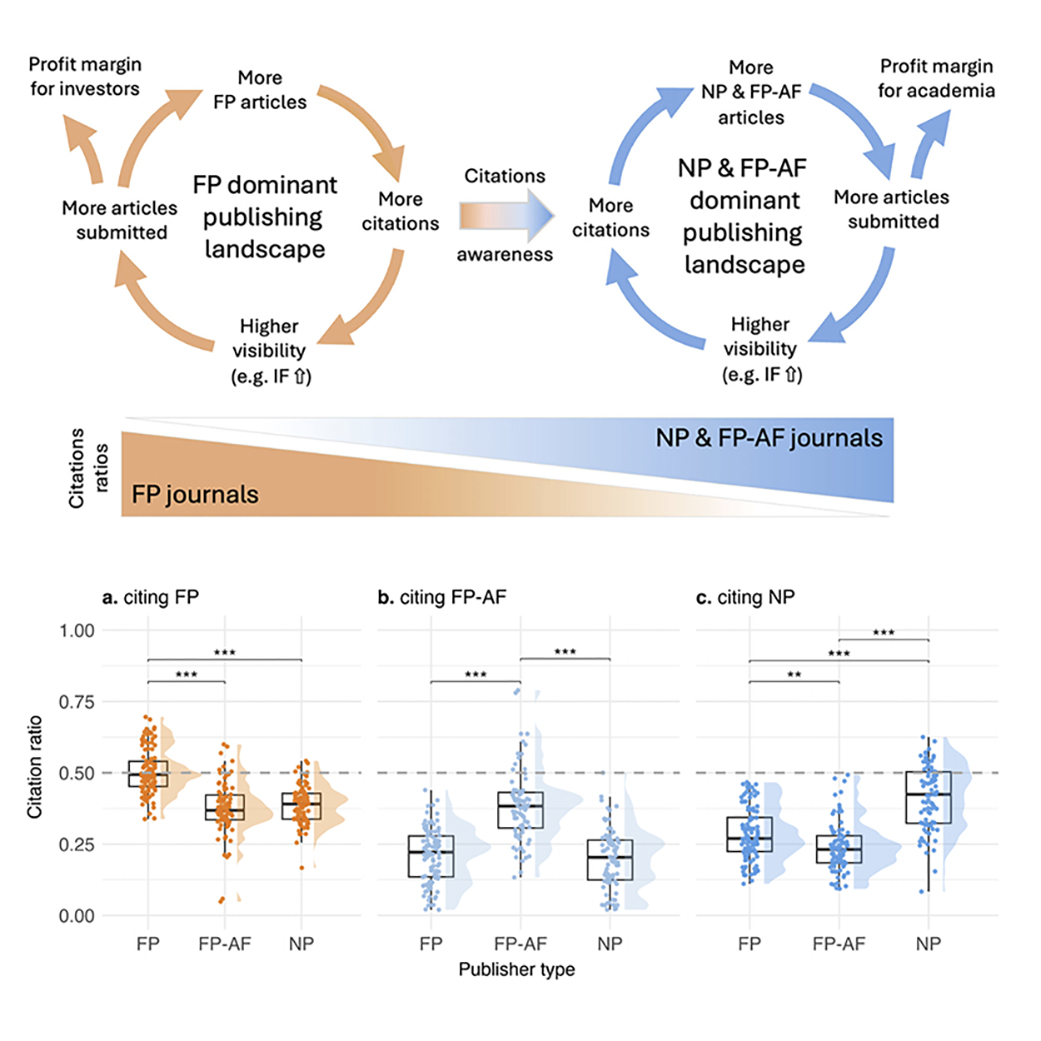
Up: Self-reinforcing dynamic of publishing landscape. Journals are shown to operate within a positive feedback loop in which higher visibility, often mediated through journal-level metrics such as the impact factor (IF), attracts more submissions, leading to increased publication volume, citations, and financial returns to investors (FP, for-profit journals; FP-AF, for-profit academia-friendly journals; NP, non-profit journals). Down : Citation pattern across journal business models. Proportion of citations in articles published in journals of different business models, shown separately for citations to (a) for-profit (FP), (b) for-profit academia-friendly (FP-AF), and (c) non-profit (NP) journals.
Full Article (PDF)